



Customers rarely think about how a company is organized behind the scenes.
They don’t think about whether they’re speaking with sales, support, billing, marketing, or another department. They don’t know which applications those teams use, where customer information is stored, or whether one system can communicate with another.
They simply experience the organization as a whole.
That distinction was at the center of our recent IdeaLab on creating faster, more connected customer experiences. While the conversation covered communications technology, Microsoft Teams, contact centers, AI, and modernization, one broader theme continued to surface:
A better customer experience often starts with improving the experience inside the organization.
When people, information, and communication channels are disconnected internally, customers eventually feel the effects.
More Ways to Communicate Aren’t Always Better
Organizations have added more ways for customers to reach them over time: phone, email, chat, SMS, social media, web forms, and more.
That sounds like progress. But adding channels doesn't necessarily create a better experience if each channel operates independently.
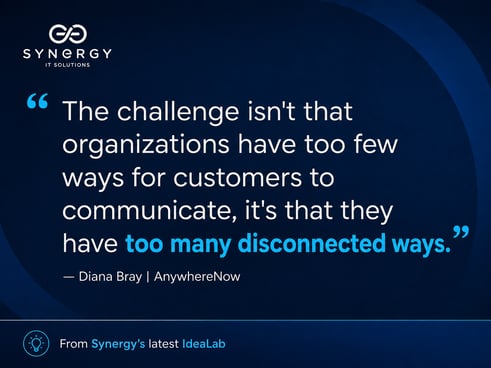 A customer may explain an issue in a chat, call later and have to explain it again, then receive an unrelated marketing email because another part of the organization has no visibility into either interaction.
Customers increasingly expect to move between communication channels without losing context. Providing that experience requires more than offering multiple ways to communicate. The information behind those conversations has to move with the customer as well.
Your Customer Sees One Company
The same principle applies internally.
Organizations naturally divide responsibilities among teams and departments. The technology supporting those teams often follows the same pattern. Sales has a CRM. Support has a ticketing system. Marketing has its automation platform. Finance has another application.
Those distinctions may make sense operationally, but they mean very little to the person on the other end of the interaction.
During the IdeaLab, a hypothetical customer was passed between departments because the employee who initially answered her call couldn't see an existing support issue. At the same time, she received an automated message from another department telling her how valued she was.
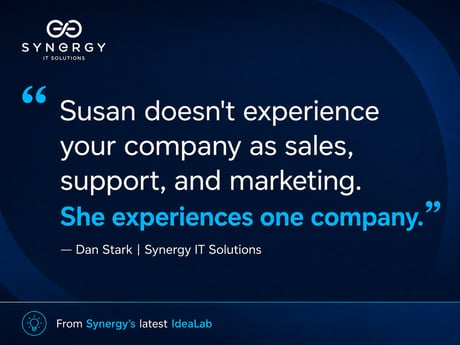 No individual employee had necessarily done anything wrong. The problem was that the organization had the information, but the person trying to help the customer didn't.
That is an important way to evaluate customer experience. Instead of asking whether each department is functioning properly on its own, organizations should also ask whether those departments can function together from the customer's perspective.
Modernization Is Bigger Than Replacing the Phone System
This is also why communications modernization shouldn't be viewed solely as replacing aging technology.
Legacy systems can certainly create practical problems. They may not support remote work particularly well, may be difficult to maintain or scale, and may offer limited integration with modern business applications.
But simply replacing an old system with a newer version of the same isolated experience misses a larger opportunity.
Modern communications platforms can increasingly connect conversations with collaboration tools, customer information, business applications, analytics, and other systems employees already use throughout the day.
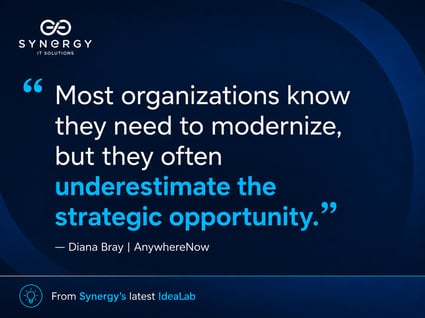 The real question becomes less about “What should replace our phone system?” and more about “How should communication work across our organization?”
That broader perspective creates opportunities to simplify the employee experience, consolidate tools, support hybrid work, improve customer engagement, and connect information that previously lived in separate places.
Context Can Matter More Than Speed
Organizations have traditionally measured service using metrics heavily focused on time.
How quickly was the phone answered? How long did the interaction last? How quickly was the ticket closed?
Speed matters, but speed without context can create a fast version of a frustrating experience.
If an employee answers immediately but then asks the customer for information they've already provided, searches multiple systems for account history, or transfers the customer somewhere else because they cannot see what happened previously, the interaction may technically be fast without being particularly good.
A more connected environment allows employees to begin an interaction with useful context: who the customer is, what they've purchased, what conversations have already occurred, whether there are open issues, and potentially why they're contacting the organization in the first place.
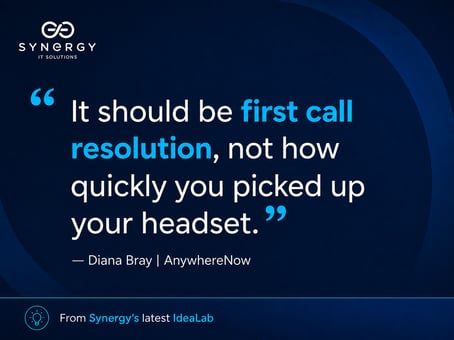 The objective isn't simply to connect a customer with an employee. It's to give that employee enough information to actually help them.
That also changes the employee experience. When relevant information is available in one place, employees spend less time searching for answers, repeating questions, or determining which department owns the problem. The discussion described this kind of 360-degree view as bringing communication history, CRM data, case information, account details, purchases, service records, and customer preferences together so the employee can quickly understand what has happened and what should happen next.
AI Should Reduce Friction, Not Add Another Layer
AI adds another dimension to this conversation, but the same principle applies. Simply introducing AI doesn't automatically improve a customer experience. Its value depends on whether it removes friction.
AI can summarize conversations, surface relevant knowledge, automate repetitive work, assist with routing, analyze interactions, and help employees find information more quickly. Used effectively, that can allow people to spend less time on administrative tasks and more time solving the customer's actual problem.
Rather than viewing AI exclusively as a replacement for human interaction, there is significant opportunity in using it to improve human interaction — providing employees with better information, eliminating repetitive tasks, and helping them respond more effectively.
And organizations don't necessarily need to transform everything at once. A practical starting point is to identify recurring points of frustration, select one problem where technology could help, measure the result, and then move on to the next opportunity.
Start With the Experience, Not the Technology
The technology behind customer communications continues to change rapidly. But the fundamental goal hasn't changed nearly as much. Customers want organizations to understand who they are, remember what has already happened, communicate through the channels that work for them, and solve their problems without unnecessary effort.
Employees want many of the same things: easy access to information, fewer disconnected tools, better visibility into what's happening, and the ability to help someone without navigating unnecessary obstacles. Those two experiences are closely connected.
Before deciding which communications technology to implement next, it may be more useful to first ask:
Where does information stop flowing today?
The answer may reveal opportunities to improve internal collaboration, simplify technology, eliminate repeated work, and create a more consistent experience for the people your organization serves.
Because ultimately, customers aren't interacting with your systems, departments, and platforms.
They're interacting with your company.
Click below to watch the IdeaLab in its entirety.
Topics discussed
Related Posts


Subscribe via email
Subscribe to our blog to get insights sent directly to your inbox.